
NEWS & TOPICS
- HOME
- NEWS & TOPICS
- First identification of a Mosasaur Premaxilla in Japan
First identification of a Mosasaur Premaxilla in Japan
2026.07.19 updateNews
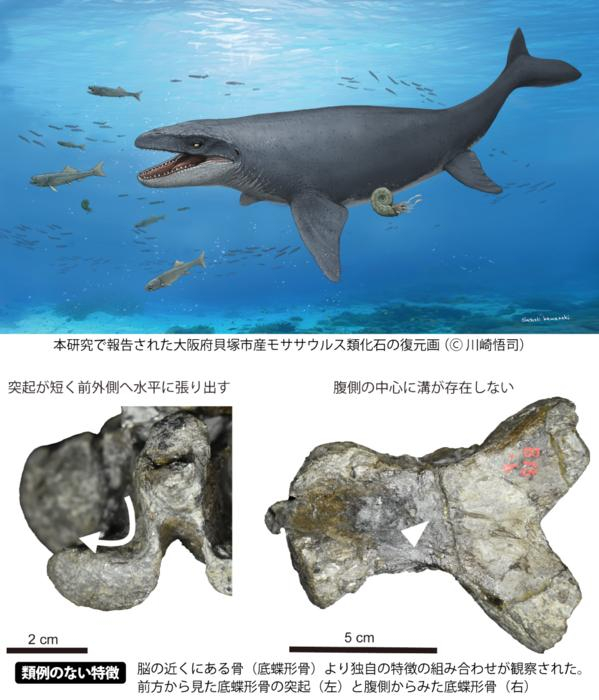
Life reconstruction of the mosasaur specimen discovered in Osaka Prefecture, Japan (top), and fossil images of the basisphenoid bone (bottom).
Mosasaurs were large marine reptiles that lived worldwide during the Late Cretaceous, approximately 98 to 66 million years ago. The fossils were originally discovered between 1990 and 1992 in Sobura, Kaizuka City, Osaka Prefecture and have been housed at the Natural History Museum, Kishiwada City. During a recent reexamination of unprepared rock specimens, researchers recovered four fossil bones that had remained embedded in the matrix.
One of these fossils, the premaxilla, represents the first confirmed occurrence of this bone in a Japanese mosasaur specimen and constitutes one of the study's most significant findings. At the time of the original discovery, the limited availability of comparative mosasaur specimens made it impossible to determine their taxonomic identity. Advances in mosasaur research over the past decades, together with the accumulation of comparative specimens and anatomical data from around the world, have now enabled researchers to recognize the bone as a premaxilla.
The team also identified distinctive features in the basisphenoid, a bone located near the braincase. These include short horn-like projections extending laterally and the absence of a ventral median groove, characteristics that differ from those of previously described mosasaurs. These anatomical traits suggest that the specimen may belong to a previously unknown species.
This discovery highlights the scientific value of reexamining unprepared specimens housed in museums and research institutions. The findings also contribute to a better understanding of marine ecosystems along the northwestern Pacific during the Cretaceous Period. Further research will be conducted to determine whether the specimen indeed represents a new species.
The results were presented at the 177th Annual Meeting of the Palaeontological Society of Japan, held at Osaka Metropolitan University on June 27, 2026.
The research team included:
Yasuaki Takano, Master's student, Graduate School of Okayama University of Science
Associate Professor Shoji Hayashi, Department of Dinosaur Paleontology, Okayama University of Science
Professor Yasuhisa Nakajima, Tokyo City University
Satoshi Utsunomiya, Panasonic Electric Works Co., Ltd.
Yuma Asai, Master's Program, University of Tsukuba
Curator Miho Kazama, Natural History Museum, Kishiwada City
Advisor Katsunori Watanabe, Natural History Museum, Kishiwada City