
NEWS & TOPICS
- HOME
- NEWS & TOPICS
- Aiming for a society that is better for both animals and people through veterinary-engineering collaboration: the “Quality of all lives” project
Aiming for a society that is better for both animals and people through veterinary-engineering collaboration: the “Quality of all lives” project
2026.06.30 updateNews
Animals contribute directly and indirectly to human society in many ways. To build a more sustainable and resilient society, we must improve the quality of life of animals, along with that of humans. This report highlights the university’s “Quality of All Lives” Project, which aims to create healthier and more fulfilling lives for both animals and humans through the emerging field of Veterinary Medical Engineering, guided by the concept of One Wellbeing.
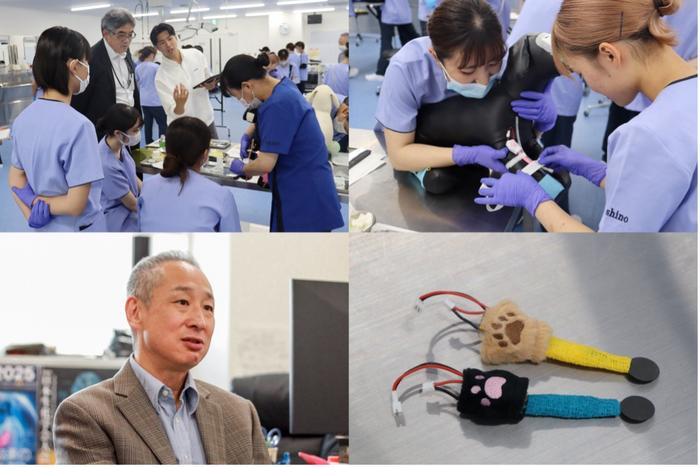
On Oct. 30, 2024, veterinary nursing practical training sessions using “Makiyoru ONE,” a bandage pressure measurement device handmade by students on the Okayama Campus, began at the Imabari Campus as teaching material for the Department of Veterinary Associated Science. The device is the first educational tool created through the university’s veterinary-engineering collaboration initiative. Professor Tetsuya Akagi of the Department of Information Science and Engineering, who led the device’s development and production guidance, expressed hopes for its educational impact.
“By allowing trainees to monitor their own performance in real time, the device enables them to improve their skills while maintaining motivation,” Prof. Akagi said.
Engineering expertise meets veterinary education needs
Akagi designed “Makiyoru ONE” in response to a request from Associate Professor Kaori Saeki of the Department of Veterinary Associated Science, who requested a compact, lightweight device — about 26 millimeters in diameter and comparable in weight to a Japanese 500-yen coin — so it would not burden dogs. To achieve this, the team used a thin lithium-ion polymer battery and selected an ultra-low-power microcontroller capable of Bluetooth Low Energy (BLE) communication with smartphones.
The team also developed hardware to transmit pressure sensor data to smartphones and created an application compatible with both Android and iPhone devices for data visualization. The development process took more than four months.
Based on the prototype, 20 devices for practical training were produced by graduate students Shumpei Yamashita and Takumi Ishibashi from the Systems Science Program in the Graduate School of Science and Engineering. After being sent to the Imabari Campus, the devices were decorated with handmade covers by Hina Mochizuki and Airi Shimokawa, students in the Department of Veterinary Associated Science.
Students cheer as their technique approaches expert-level performance
The training focused on techniques for placing intravenous catheters. About 30 second- and third-year students in the Department of Veterinary Associated Science worked in groups in a surgical practice room on the fourth floor of the Okayama University of Science Veterinary Medical Teaching Hospital, using “Makiyoru ONE” while practicing IV catheter placement on canine training models.
Bandages that are wrapped too tightly can cause circulatory problems, so students must learn to apply appropriate pressure. The students repeatedly practiced while comparing their pressure measurements with benchmark values previously recorded by experienced instructors, including Dr. Saeki and Junior Associate Professor Takamasa Itoi of the Department of Veterinary Medicine. When their measurements approached expert-level values, students celebrated with cheers and smiles.
Visualizing “feel” to improve learning efficiency
“This device allows users to quantitatively and instantly confirm how much pressure is being applied to a leg during bandaging,” Dr. Akagi explained. “Differences in technique between experts and students become clearly visible as numerical data, which also helps motivate learners.”
Takumi, the graduate student, said that testing the devices in real training sessions revealed additional challenges, including sensor shape improvements and expanding the measurement range.
“It’s rewarding to see that the devices we created are actually being used and helping students,” Takumi said.
Shumpei was also excited by the opportunity to observe the training sessions.
“Seeing the device being used in the actual training session gave me a strong sense of accomplishment,” he said.
Dr. Saeki emphasized the educational benefits of the project.
“Students told us that being able to check their techniques while looking at numerical data was extremely helpful,” Dr. Saeki said. “We hope that visualizing what was previously dependent on intuition will improve learning efficiency.”
Creating a new academic field: Veterinary Medical Engineering
Professor Masumi Eto, director of the “Quality of All Lives Center,” which was established this April on the Imabari Campus, shared the project’s vision for the future.
“Animals enrich our lives in countless ways, as companions, partners in agriculture, and members of our communities,” Prof. Eto said. “To build a society where both animals and people can thrive together, we are bringing veterinary medicine and engineering together to create innovative technologies that improve the Quality of All Lives.”
Researchers at the center are developing and testing a wide range of devices, such animal-specific vital monitoring systems as well as technologies that support livestock production, veterinary education, and clinical veterinary care. The team is also working to practical solutions for emerging social challenges, such as enabling pet owners to evacuate safely with their partners during natural disasters. Through these efforts, the project aims to realize a future of smart animal healthcare that benefit both animals and the people who care for them.”
Since academic year 2024, the university has participated in the Ministry of Agriculture, Forestry and Fisheries’ “Field for Knowledge Integration and Innovation (FKII)” research and development platform, which promotes collaboration among industry, academia, and government. In addition, pet food and animal-care towels developed with local companies are now being sold at the Kurushima Kaikyo Service Area along the Shimanami Expressway, expanding the project as a new regional initiative.
“Through these activities, we hope to establish a new academic field called ‘Veterinary Medical Engineering’ and foster animal-related industries in western Japan’s Chugoku and Shikoku regions,” Prof. Eto said.
By bringing together the strengths of the university’s Okayama and Imabari campuses, the Center for Quality of All Lives (CQOAL) continues to pioneer new approaches at the intersection of veterinary medicine and engineering. Through these efforts, CQOAL creates innovations that support happier lives for animals and people, in line with the concept of One Wellbeing.